


LINTON, IN — A local man’s attempt to offer a public "thank you" to city officials has instead reignited a long-standing battle over disability rights, highlighting a potential clash between city policy and federal law. Linton News received an exclusive interview with resident Jarod Lee and completed an in depth investigation looking into this matter.
Jarod Lee, a Linton resident who is physically unable to leave his home due to a disability, claims the city is using local "loopholes" to deny him a voice in government. The conflict peaked during the March 9 city council meeting, where Lee was barred from providing public comment via phone or video stream, an accommodation he requested three weeks in advance.
The Three-Week Silence
According to Lee, his attempt to participate began on February 13. He contacted the mayor's office and spoke with the secretary Nyla, to relay a request to the Mayor’s office, asking for a remote accommodation to speak at the upcoming meeting. Lee says he received no response for twenty days.
On the afternoon of the meeting, Lee called the Mayor’s office to check his status on receiving accommodations to be able to speak, assuming from the lack of response that it was going to be no issue. It was only then, hours before the event, that Mayor John Preble informed him that his request was denied, citing a city policy requiring physical attendance.
Lee stated he never received a phone call or email during the three-week window to discuss alternatives for his public comment or to tell him he would be denied that right.
The Policy Dispute
In a request for comment regarding this situation Mayor Preble stated:
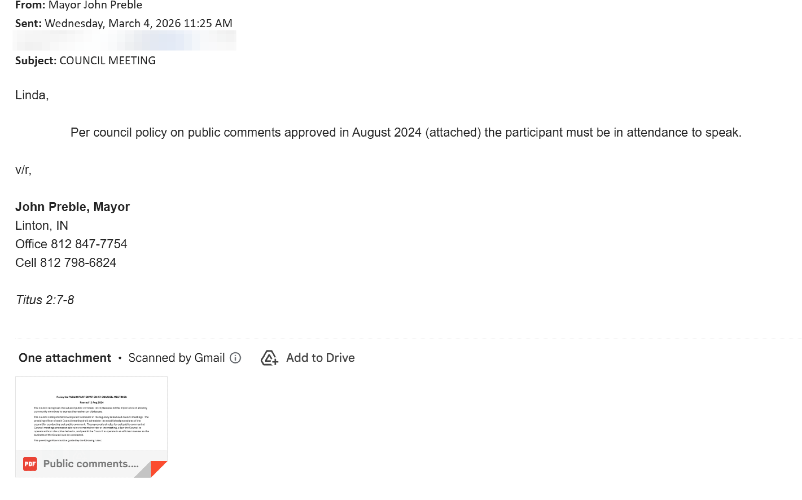
His request came through Linda Bedwell (see note below). I reviewed if this was technically possible and if allowed. In reviewing the council policy on public comments, as you are aware, item B states the participant must be present and sign in to provide comments. I sent an email to Linda on 4 March 2026 attaching the public policy document and reminded her the participant must be present.
(Editor Note: After speaking with the mayor he clarified that he was not sure who Jarod's request came through and eventually came to understand Jarod had spoken with Claudia not Linda about this. This was confused due to prior interactions involving the conservation club discussion that Linda was a part of with Jarod.)
It was my understanding she was to let him know. He, Jarod, contacted me shortly before the meeting asking what he needed to do to call in. I conveyed to him the public policy on making comments, passed by the council in Aug 2024, and the requirement to be in attendance.
(I) Also conveyed that I sent an email to Linda earlier reminding her of the policy and thought she had passed this information on to him. I then advised him he could submit something in writing to be read at the meeting in accordance with the policy. This he did through a text to Linda, which she read.
Linda Bedwell was unaware of all of this and stated she has no record of such an email and only learned of the situation when Lee contacted her directly on the day of the meeting, distraught after being denied access.
(Editor Note: Mayor Preble provided a copy of an email sent five days prior to the meeting, which outlined the public comment policy and the requirement for in-person attendance. While the message apparently never reached Councilwoman Bedwell, likely due to a technical error, its worth noting that because she was not the original point of contact for the request, she had no reason to be monitoring her correspondence for the Mayor’s directive.)
A Statement Read in Proxy
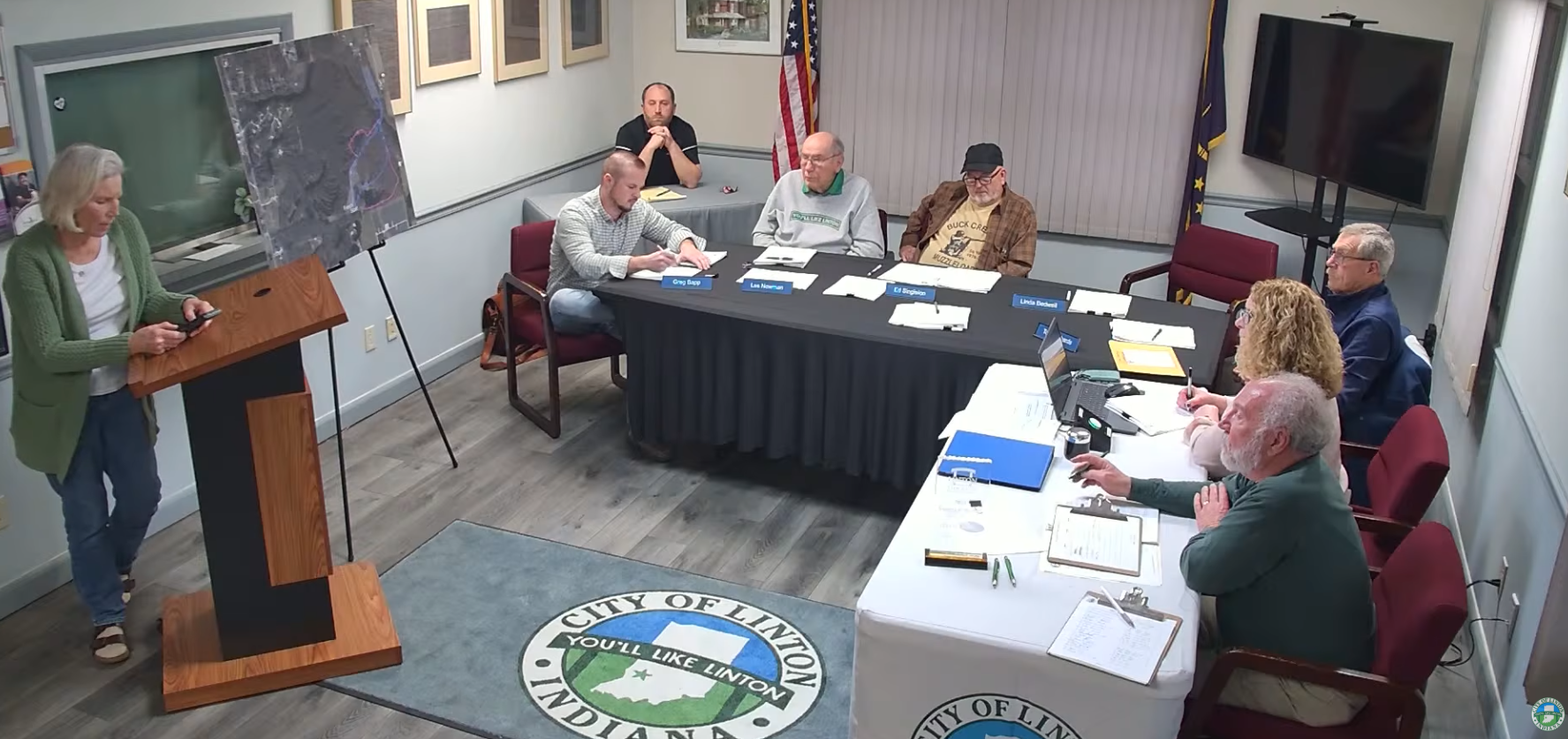
Unable to speak himself, Lee sent a text to Councilwoman Bedwell asking if she would be willing to read it for him during the meeting, which she agreed and did during the public comment section.
"I was denied time to speak during public comments because of my disability preventing me from attending in person," Lee’s statement read. "A telephone on speaker before the council is not unreasonable... A disability is not a burden; inaccessibility is."
Ironically, Lee had intended to use his time to thank the city for recent progress regarding the Linton Conservation Club, the very site that sparked a 2019 ACLU lawsuit between Lee and the city.
City Policy vs. Federal Law
In that statement, Mayor Preble cited a council policy passed in August 2024. Item B of that policy requires participants to be physically present and sign in to provide comments. Preble stated he advised Lee he could instead
"submit something in writing to be read at the meeting,"
which Councilwoman Linda Bedwell eventually did on Lee’s behalf after Lee reached out to her to request her to do so.
However, the Americans with Disabilities Act (ADA) suggest that a written statement may not be a "reasonable modification." Under 28 CFR § 35.160, the "Effective Communication" rule requires that a city’s communication with disabled residents be just as effective as its communication with others.
Furthermore, the "Primary Consideration" rule mandates that when a city decides on an accommodation, they must give priority to the specific request made by the person with the disability. By forcing Lee to submit a text while others spoke in person, the city may have created a "second-class tier" of participation.
This disparity raises a fundamental question of due process: how does the city expect a disabled citizen to make a meaningful public comment if they are denied the ability to hear the real-time deliberations of the meeting?
A pre-written comment is, by definition, static; it removes any capacity for the speaker to react to new evidence, counter-arguments, or testimony presented during the session. While able-bodied citizens can pivot their testimony based on the evening's discussion, a disabled citizen relegated to a pre-submitted text is silenced on anything that occurs after they hit "send."
The 2026 Legal Standard
The refusal is particularly notable given recent updates to Indiana law. Under Indiana Code § 5-14-1.5-2.9, most governing bodies are now required to provide live transmissions of their meetings.
Some would argue that since the city is already using technology to livestream meetings, the "bar" for refusing a remote comment is extremely high. Unless the city can prove that a speakerphone or Zoom link would be an "undue financial or administrative burden", a difficult argument in 2026, they are generally required to provide the modification.
A History of Friction
The tension in Linton dates back to 2019, when the city placed locked gates on the 600-acre Conservation Club. Lee, who uses a wheelchair, requested a key for vehicle access. Under past Mayor John Wilkes, the city refused, despite other groups having keys. Lee filed an ACLU lawsuit. Rather than accommodating Lee, the city chose to shut down the entire property to the public.
The issue resurfaced recently when the city nearly leased the property to the high school cross-country team, which would have violated the legal settlement requiring the city to consult Lee first. While Councilwoman Bedwell intervened to stop that error and began working with Lee on a compromise, this latest denial has soured the progress.
Legal Consequences
Jarod Lee confirmed he has filed a formal complaint with the Department of Justice (DOJ), alleging that the city’s refusal to provide a remote speaking accommodation constitutes a direct violation of his civil rights. Lee also stated he is currently in the process of retaining legal counsel to pursue a discrimination lawsuit.
While the city may feel protected by its 2024 policy, the financial stakes for Linton residents are high. If a lawsuit is filed, the city will be forced to defend its policy in court. Win or lose, taxpayers will likely be on the hook for thousands or tens210401 of dollars in legal fees, a bill many residents say could have been avoided with a simple speakerphone or Zoom link. Critics argue that risking a costly legal battle over a "thank you" statement is a high price for taxpayers to pay for what appears to be an easily avoidable administrative hurdle.
“Equal Means Equal”
In the statement read by Bedwell at the meeting, Lee stated:
"I was told to submit it in writing... but have yet to figure out how to write about a meeting that hasn’t happened. A telephone on speaker before the council is not unreasonable... A disability is not a burden; inaccessibility is."
Lee, who originally just wanted to thank the city for reopening dialogue on the Conservation Club, now feels he has no choice but to return to the courtroom.
"They [the city] can’t just pretend that we doesn’t exist," Lee said. "They must give disabled citizens access to meetings and city property just like everyone else. It’s about making progress for the future. It’s not just for me but all citizens that struggle to navigate inaccessibility in Linton"
The next Public Meeting is April 13th at 6pm.
City Hall
86 S Main St
Linton, IN 47441
- Phone: (812) 847-7754
- M - F 8:00 a.m. - 4:30 p.m.
Closed for lunch 11:30 - 12:30